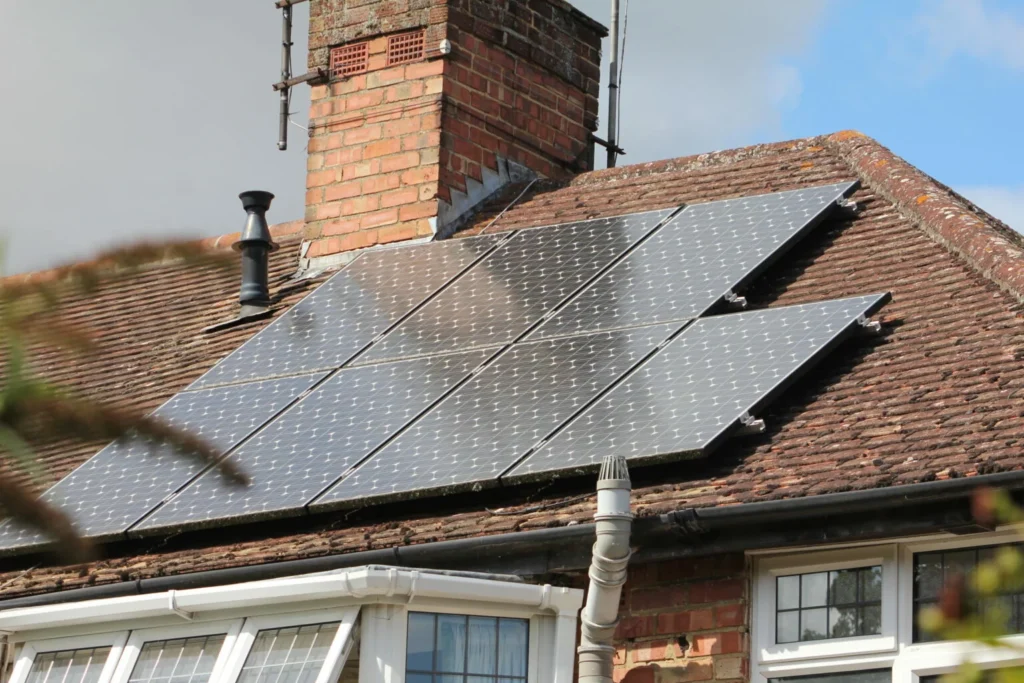
Drive down any street in the UK today, and you will see the glimmer of blue-black glass on rooftops. Solar panels (Solar PV) have moved from being a niche eco-hobby to a mainstream home improvement. They are often presented as a “no-brainer” , a straightforward way to slash bills and stick it to the energy companies.
For some households, they are exactly that. We see clients who save thousands of pounds a year and run their cars for “free.”
For others, the reality is underwhelming. The payback period stretches to 20 years, and the bills barely move.
The difference usually isn’t the panels themselves. It comes down to how the home uses electricity, how the system is planned, and how solar fits into the wider picture.
Understanding these hidden factors before you bolt panels to your roof is the key to avoiding disappointment.
What solar panels are designed to do
To manage expectations, we need to strip away the marketing. Solar panels do not “power your home” in the way a grid connection does. They provide a variable, weather-dependent stream of energy.
- They generate power during daylight hours: Obviously. But specifically, they peak between 11 am and 3 pm.
- They generate electricity, not heat: Unless you have electric heating (like a heat pump), solar panels won’t directly warm your house.
Crucially, solar panels do not store energy. Without a battery, any energy you generate but don’t use immediately flows straight out of your house and into the National Grid.
The “Use It or Lose It” Reality
This is the most overlooked aspect of solar economics.
In the UK, electricity prices are currently unbalanced:
- Buying electricity (Import): Costs approx. 24p – 28p per kWh.
- Selling electricity (Export): Under the “Smart Export Guarantee” (SEG), energy companies pay you approx. 4p – 15p per kWh.
The Maths: If you generate 1 kWh of electricity and export it, you earn 5p. Later that evening, you boil the kettle and have to buy that 1 kWh back for 25p. You have effectively lost 20p.
Therefore, the financial success of solar depends entirely on Self-Consumption: using the power while it is being generated.
Electricity use matters more than system size
Two neighbours can have the exact same 4kW solar array but see totally different savings.
- Neighbour A (The Retiree): Home all day. Does the washing, vacuuming, and slow-cooking between 10 am and 2 pm. They use 80% of their solar power directly. Result: Huge Savings.
- Neighbour B (The Commuter): Leaves at 8 am, returns at 6 pm. The house is empty while the sun shines. They export almost everything for pennies and buy expensive grid power all evening. Result: Low Savings.
Before you buy solar, ask yourself: Can I shift my lifestyle to match the sun?
Solar panels without a battery: What to expect
Many “budget” solar installations do not include a battery. In these homes, the panels are a “use it or lose it” resource.
- Summer: You will likely generate far more than you can use.
- Winter: You will generate very little (solar output in December is often 10% of that in June).
- Evenings: You are 100% reliant on the grid.
Is it worth it? Yes, if you work from home or have an Electric Vehicle (EV) plugged in during the day. If not, a battery becomes essential.
Solar panels with a battery: The Game Changer
Adding battery storage changes the physics of the system. It allows you to bottle that midday sunshine and use it to cook dinner at 7 pm.
The Benefits:
- Flexibility: You don’t have to stress about running the washing machine at noon.
- Smart Trading: With modern “Smart Tariffs” (like Octopus Agile or Intelligent), you can charge the battery from the grid at 2 am when electricity is cheap (e.g., 7p/kWh) and discharge it during peak times. This turns your battery into a money-saving machine even in winter when there is no sun.
The Downside: Batteries are expensive. A decent 5kWh-10kWh battery can double the cost of the installation. You need to calculate if the savings over 10 years justify the upfront cost.
Roof suitability: The “South-Facing” Myth
Everyone knows you need a south-facing roof, right? Not necessarily.
While a South-facing roof generates the most total energy, it generates it in a big lump at midday (when most people are out). East/West facing roofs are often better for working families.
- East Roof: Catches the morning sun (perfect for breakfast/showers).
- West Roof: Catches the evening sun (perfect for dinner/TV).
This “smoother” generation profile matches human behaviour better than a South-facing spike.
Shading is a killer. A single branch casting a shadow on one panel can drag down the performance of the whole string (like standing on a hosepipe). If you have shading issues (trees, chimneys, dormers), you may need Microinverters or Optimisers, which allow each panel to work independently.
Solar panels and older properties
Can you put solar on a Victorian terrace? Absolutely. But you need to check:
- Structural Strength: Solar panels are heavy. Can your 100-year-old rafters take the weight? (A structural survey is vital).
- Roof Condition: Solar panels last 25 years. If your slate roof needs replacing in 5 years, do not install panels now. You will have to pay to take them off and put them back on later.
- Heritage: In Conservation Areas (common in London/Oxford), street-facing panels are often restricted. However, panels on the rear or side elevations are usually Permitted Development.
Solar panels don’t fix inefficient homes
This is a crucial “Cosy Homes” principle. Generating electricity does not reduce heat loss.
If you live in a freezing cold house and spend £3,000 a year on gas heating, spending £10,000 on solar panels won’t help you much. Solar generates electricity, not gas. Even if you use electric heaters, the solar production in winter (when you need the heat) is negligible.
Fabric First: Spend your budget on insulation and draft-proofing first. Once the energy demand is low, then install solar to power what remains.
Interaction with other home upgrades (The “Eco-System”)
Solar panels are the “fuel station” for the modern home. They work best when paired with technologies that can “soak up” the excess power.
- The Heat Pump: A well-insulated home with a heat pump can be partially heated for free by solar (especially in the “shoulder months” of Spring/Autumn).
- The Electric Vehicle (EV): An EV has a huge battery. With a “Zappi” or similar smart charger, you can tell your car to only charge using excess solar power. This is effectively free driving.
- The Immersion Diverter: A small device (like an iBoost) that sends spare solar energy to your hot water tank, giving you a tank of free hot water instead of exporting it for pennies.
Maintenance and longevity considerations
Solar is low maintenance, but not “no maintenance.”
- Cleaning: In the UK, rain does a decent job, but bird mess or lichen buildup can reduce output by 10-15%.
- Inverters: The panels last 25 years, but the Inverter (the box that converts the power) typically lasts 10-12 years. You should budget for a replacement (£800-£1,500) halfway through the system’s life.
- Pigeons: Solar panels provide a warm, sheltered roof for pigeons. We strongly recommend installing bird mesharound the perimeter during installation to stop them nesting underneath.
When solar panels may not be the right priority
Honest advice: Don’t buy solar if…
- You have a North-facing roof.
- You have massive shading from tall trees that you cannot cut down.
- You are moving house in 3 years (you likely won’t recoup the investment).
- Your house is damp and cold (fix the fabric first).
Why independent advice matters for solar decisions
The solar industry is full of aggressive sales tactics (“Sign today for a 50% discount!”). Independent advice helps you cut through the noise. It calculates your real-world return on investment based on your actual usage data, not an optimistic brochure.
Questions homeowners should ask before installing solar
- “What is your estimated output in December, not just July?”
- “Are you including bird protection in the quote?”
- “What is the warranty on the Inverter vs the Panels?”
- “Have you included scaffolding in the price?”
Taking the next step
Solar panels can be a valuable addition to many homes a way to gain energy independence and lower your carbon footprint. But they are a significant investment that requires planning.
If you’d like to understand whether solar panels make sense for your home, and how they might fit into a wider improvement plan, you can book a free, no-obligation conversation with our team. We help you look at the numbers, not just the sales pitch.
Let's make things happen
Tell us about your home and we’ll join up the right energy upgrades so everything works as one simple plan.

Ready to take the first step?
Start your journey to a cosier more efficient home
Fill out the quick form below, and a member of our team will get in touch with information on how the service works and the next steps.