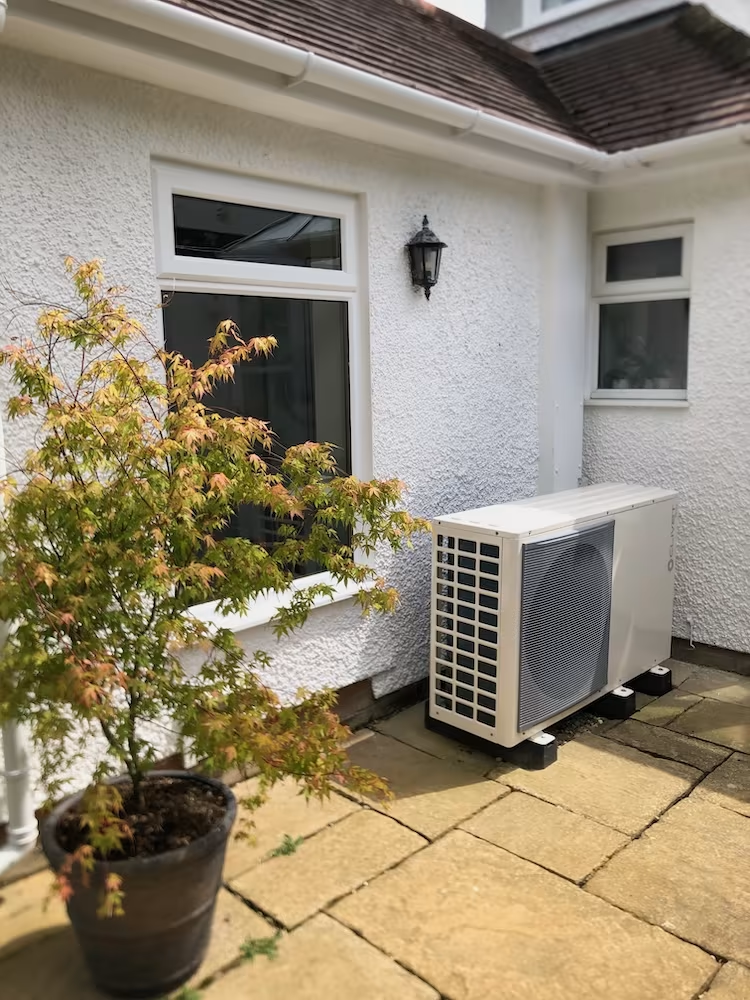
Heat pumps are dominating the headlines. Whether you are scrolling through social media, reading the Sunday papers, or talking to neighbours, the conversation about switching from gas boilers to low-carbon heating is everywhere.
When they work well, heat pumps are fantastic. They provide a steady, gentle warmth that makes a home feel cosy around the clock, often with lower carbon footprints and steady running costs.
But when they don’t work well, the stories can be scary: skyrocketing electricity bills, lukewarm radiators, and homeowners shivering in their living rooms.
The difference is rarely the technology itself heat pumps are a mature technology used successfully in Scandinavia for decades. The difference is usually whether the home was ready for a heat pump in the first place.
Understanding what makes a home suitable and what preparation may be needed is the key to avoiding disappointment and ensuring your investment pays off.
What a heat pump actually does
To understand if your home is ready, you need to understand how the machine works. It is not just a “boiler swap.”
A traditional gas boiler creates heat by burning fuel at extremely high temperatures (fires burn at 1000°C+). This allows it to blast water around your radiators at 70°C-80°C, heating a cold, drafty room very quickly.
A heat pump works more like a fridge in reverse. It extracts low-grade heat from the outside air (even on cold days), compresses it to upgrade the temperature, and moves it inside. Because of this process, heat pumps:
- Run cooler: They typically circulate water at 35°C-50°C (low flow temperature).
- Run longer: They provide steady, background heat rather than rapid bursts.
- Rely on retention: They rely on the home holding onto that heat effectively.
This means the condition of your building fabric plays a much bigger role in performance than it does with a gas boiler. A boiler can muscle its way through a drafty house; a heat pump cannot.
Why some heat pump installations disappoint
Most horror stories stem from a mismatch between the machine and the building. If a home loses heat faster than the pump can gently replace it, the pump has to work at maximum capacity constantly. It might have to use its “backup” heater or run at higher temperatures, which drastically reduces its efficiency (COP – Coefficient of Performance).
The Result: A cold house and a huge electricity bill.
Heat loss is the first thing to understand
Before you even look at a brochure for a heat pump, you need to look at your walls, roof, and windows. Heat Loss Calculation is the holy grail of heat pump design.
Homes with:
- Uninsulated solid walls
- Single glazing
- Drafty suspended floors
- Thin loft insulation
…are like leaking buckets. Trying to fill a leaking bucket with a trickle of water (a heat pump) is impossible. You need to plug the holes first.
Fact Check: You do not need a “Passivhaus” (ultra-low energy home) to have a heat pump. But you do need a home where the heat loss is reasonable and predictable.
Insulation doesn’t have to be perfect but it does matter
A common misconception is: “I can’t have a heat pump because I live in an old Victorian house.”
This is false. You can heat a tent with a heat pump if the pump is big enough but it will cost a fortune. The goal is suitability.
- Can you insulate the loft? (Cheap and easy).
- Can you draft-proof the windows?
- Can you fill the cavity walls?
Doing the “easy wins” first often reduces the heat demand enough to make a heat pump viable and affordable to run.
Heating distribution: The “Emitter” Challenge
Because heat pumps run at lower temperatures (45°C vs 75°C), your radiators need to be bigger to output the same amount of heat.
- Surface Area: A radiator at 45°C feels lukewarm to the touch. To heat the room, you need more surface area (bigger radiators or underfloor heating).
- Pipework: Old “microbore” pipework (tiny 8mm or 10mm pipes often found in 70s/80s homes) can restrict the flow rate required by heat pumps.
The Check: Is your home ready for bigger radiators? Do you have space on the walls? If you have Underfloor Heating (UFH) already, you are in a great position, as UFH is the perfect partner for heat pumps.
Ventilation and airtightness
As you insulate to prepare for the heat pump, you make the home more airtight. Heat pumps prefer a stable environment without howling gales blowing through the floorboards.
However, as we always say: Build Tight, Ventilate Right. If you seal the drafts to help the heat pump, you must add vents (trickle vents or mechanical fans) to help the occupants breathe. A stuffy, damp house is not a comfortable one, no matter how efficient the heating is.
Hot water demand matters too
Boilers produce instant hot water (Combi) or heat a tank rapidly. Heat pumps heat water more slowly.
- The Cylinder: You will almost certainly need a hot water cylinder. If you currently have a Combi boiler, do you have a cupboard space to put a tank back in?
- The Coil: Heat pump cylinders need a special “large surface area coil” inside them to transfer the heat effectively. You usually cannot reuse your old copper cylinder.
Electrical capacity and infrastructure
Heat pumps run on electricity.
- The Supply: Does your home have a standard single-phase fuse (usually 60A, 80A, or 100A)? If you have an electric shower, an EV charger, and an induction hob, adding a heat pump might overload your main fuse.
- DNO Application: Your installer must apply to the District Network Operator (the people who run the grid) to check if the local grid can handle your heat pump.
Noise, space, and location considerations
- Space: You need a space outside for the unit (about the size of a washing machine). It needs airflow (don’t box it in).
- Noise: Modern pumps are quiet (like a fridge humming), but planning rules in the UK usually require them to be at least 1 metre from the boundary of your neighbour’s property to prevent noise nuisance. In terraced streets, this can be tricky.
Why heat pumps work best as part of a whole-home plan
This is why we advocate for the Whole House Plan. Installing a heat pump is the final piece of the jigsaw, not the first.
The Ideal Sequence:
- Fabric: Fix the roof, insulate the loft, draft-proof.
- Ventilation: Ensure fresh air supply.
- Emitters: Upgrade radiators / pipework.
- Heat Source: Install the heat pump.
If you jump straight to Step 4, you risk skipping the essential preparation that makes the system efficient.
Can homes be prepared for heat pumps in stages?
Yes. You don’t have to do it all at once. You can spend Year 1 and Year 2 improving the insulation and windows. In fact, you can even install “Heat Pump Ready” radiators while you still have your gas boiler. They will work perfectly fine with gas (even better, actually), and it means when the boiler eventually dies, the house is ready for the switch.
Common misconceptions regarding readiness
- “Heat pumps don’t work in cold weather.”
- Fact: Heat pumps work efficiently down to -15°C and beyond. They are the standard heating system in Norway and Sweden. The machine works fine; it’s the house insulation that usually fails in the UK cold.
- “You need to rip out all your floors.”
- Fact: Only if you want underfloor heating. Oversized radiators are a perfectly acceptable alternative.
When a heat pump may not be the right choice (yet)
Honesty is important. Sometimes, the answer is “No” (or at least, “Not yet”).
- If you have a listed building where you cannot upgrade single glazing.
- If you have absolutely no space for a hot water cylinder.
- If your electricity supply is constrained.
In these cases, a Hybrid System (Heat pump + Gas Boiler working together) or simply focusing on insulation first might be the smarter choice.
Why independent advice is valuable
Heat pump salesmen sell heat pumps. They are incentivised to say “Yes.” Independent Retrofit Coordinators sell performance. They are incentivised to ensure you are warm.
Getting an independent assessment gives you the unvarnished truth about your heat loss and your readiness, before you commit £10,000+ to an installation.
What homeowners can do before deciding
- Look at your EPC: (But treat it with caution).
- Try the “Boiler Test”: Turn your gas boiler flow temperature down to 50°C on a cold day. If your house stays warm, your radiators and insulation are likely good enough for a heat pump. If you freeze, you need upgrades first.
- Check your fuse box: Do you have space for a new circuit?
Taking the next step
If you’re curious about heat pumps but unsure whether your home is ready, starting with understanding rather than commitment is the most helpful approach.
A conversation focused on readiness can clarify what’s already suitable, what needs attention, and whether a heat pump makes sense now or later.
If you’d like to talk through your home and explore whether a heat pump could work for you, you can book a free, no-obligation conversation with our team.
Let's make things happen
Tell us about your home and we’ll join up the right energy upgrades so everything works as one simple plan.


Ready to take the first step?
Start your journey to a cosier more efficient home
Fill out the quick form below, and a member of our team will get in touch with information on how the service works and the next steps.