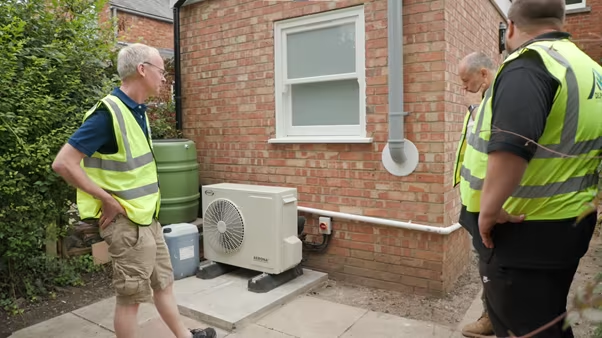
1. Provide steady, even heating
If you are used to the “cycle of discomfort” with gas central heating where the radiators scorch you, then the room cools down, then they scorch you again a heat pump will feel like a luxury upgrade.
Because they run for longer periods at lower flow temperatures (typically 35°C – 45°C), they create:
- Fewer temperature swings: The house temperature remains stable.
- Consistent comfort: The fabric of the building stays warm, eliminating that “chill” you feel when the boiler clicks off.
- Silence: Modern units are incredibly quiet, maintaining warmth without the roar of a firing boiler.
2. Reduce reliance on fossil fuels
This is the big macro benefit. Heat pumps run on electricity. As the UK grid gets greener (with more wind and solar power), your heating gets greener automatically.
- Carbon Savings: Even with today’s grid mix, a heat pump generates significantly less CO2 than burning gas or oil.
- Future Proofing: You are decoupling your home from the volatile gas market.
3. Work well with modern heating systems
Heat pumps are the perfect partner for Underfloor Heating (UFH). Since UFH covers a large surface area, it doesn’t need hot water to heat a room; lukewarm water is perfect. This allows the heat pump to run at its maximum efficiency (known as the Coefficient of Performance, or CoP). They also work brilliantly with oversized radiators designed for low-temperature heating.
4. Integrate with other upgrades
A heat pump is the heart of the “Smart Home” energy system.
- Solar Panels: You can power your heat pump with your own free electricity.
- Batteries: You can store cheap overnight energy to run the pump during the day.
- Smart Tariffs: You can automate the heating to run when electricity is cheapest.
What Heat Pumps Don’t Do Well
1. They don’t fix heat loss
This is the number one cause of heat pump dissatisfaction. A heat pump cannot compensate for a leaky home.
A gas boiler has a massive power output (often 24kW or 30kW). If you leave a window open, a boiler can simply burn more gas to overpower the cold air. A heat pump (often 5kW to 12kW) cannot do this.
If your walls, roof, or floors allow heat to escape easily, the heat pump will struggle to keep up. It will run at maximum power constantly, killing its efficiency and driving up your electric bill.
Rule #1: Insulate first, heat pump second.
2. They don’t provide instant heat
Heat pumps are not designed for the “boost” button generation. If you let your house drop to 12°C while you are at work, and then try to heat it to 21°C when you get home at 6pm, a heat pump will struggle. It might take hours to lift the temperature that much.
Heat pumps work best with a “Setback” strategy: keeping the house at 18°C during the day and nudging it up to 21°C in the evening. If you want instant heat the moment you walk in the door, a heat pump requires a change in habits.
3. They don’t suit every home immediately
Not every home is “Heat Pump Ready” out of the box.
- Microbore Pipework: Tiny pipes (8mm/10mm) found in many 1970s/80s homes restrict the water flow too much for standard heat pumps.
- Single Glazing: The heat loss is often too high.
- Space: You need space for the outdoor unit (airflow) and space inside for a hot water cylinder (no more combi-boiler compactness).
In these cases, preparation work (re-piping, glazing upgrades) is needed before the install.
4. They don’t automatically reduce bills
This is a tough truth. While heat pumps are 300% to 400% efficient (compared to a boiler at 90%), electricity in the UK is currently about 4 times more expensive per unit than gas.
This means that financially, a heat pump often just breaks even with a gas boiler.
- If designed badly (low efficiency): It will cost more to run.
- If designed well (high efficiency): It will cost less to run.
Savings are not guaranteed; they are earned through good design and insulation.
Why expectations matter so much
Many negative experiences with heat pumps come down to mismatched expectations rather than system failure.
If a homeowner expects:
- Radiators that are hot to the touch (scorching).
- The ability to turn the heating off all day and blast it for 2 hours at night.
- A bill cut in half instantly.
…they will be disappointed.
If a homeowner expects:
- Radiators that are lukewarm but a room that is always 21°C.
- A heating system that hums away quietly in the background.
- A low-carbon home that is comfortable 24/7.
…they will be delighted.
The importance of system design
With a gas boiler, an installer can guess the size (“Just put a 30kW in, it’ll be fine”) and get away with it. With a heat pump, precision is mandatory.
Key design factors include:
- Room-by-Room Heat Loss: Calculating exactly how much energy each room loses.
- Emitter Sizing: Changing radiators that are too small.
- Flow Rates: Balancing the system so water flows at the correct speed.
Poor design undermines even the most expensive equipment.
Heat pumps and older homes
Myth Buster: You can put heat pumps in old Victorian homes. We have seen successful installations in Grade II listed buildings and 100-year-old cottages.
However, older homes require a more thoughtful approach.
- You might accept that on the 3 coldest days of the year, the system needs backup.
- You might need to focus heavily on draft-proofing and loft insulation first.
- You might need a “High Temperature” heat pump (specialist models that can output 60°C+ water).
Old does not mean impossible it just means “handle with care.”
Behaviour and comfort expectations
Owning a heat pump requires a mental shift. You stop “heating the person” (blasting the radiator when you are cold) and start “heating the space” (maintaining the environment).
Occupants who adapt learning to leave the thermostat alone and let the weather compensation controls do the work experience the best comfort and the lowest bills.
Heat pumps as part of a bigger picture
This brings us back to the Whole House Approach. A heat pump should not be viewed as a standalone purchase, like a new TV. It is part of the property’s ecosystem.
Ideally, you improve the Fabric (insulation/windows) to reduce the demand. Then you improve the Ventilation to ensure health. Finally, you install the Heat Pump to meet that reduced demand efficiently.
When a heat pump may not be the right choice
Sometimes, honest advice is to say “Not yet.”
- If you have a limited budget, spend it on insulation first. It will lower your bills immediately and make the heat pump cheaper to install later (because you will need a smaller unit).
- If you have absolutely no space for a hot water cylinder, a heat pump might be logistically impossible without significant renovation.
Why independent advice helps
Heat pump installers are salespeople. They want to sell units. Independent guidance focuses on suitability.
It helps you:
- Verify if your current radiators will work (saving you money on replacements).
- Identify the “dealbreakers” (like microbore pipework) before you start.
- Calculate the realistic running costs based on your electricity tariff.
Taking the next step
If you’re interested in heat pumps but want to understand whether they’re right for your home and under what conditions starting with clarity rather than commitment is the best approach.
Do you know your home’s heat loss? Do you know if your radiators are “heat pump ready”?
If you’d like to explore this further, you can book a free, no-obligation conversation with our team to talk through your property and options. We help you look past the sales pitch and look at the physics.
Let's make things happen
Tell us about your home and we’ll join up the right energy upgrades so everything works as one simple plan.


Ready to take the first step?
Start your journey to a cosier more efficient home
Fill out the quick form below, and a member of our team will get in touch with information on how the service works and the next steps.